
The definition of television advertising has changed dramatically.
Today's viewers don't consume television through a single screen, provider, or platform. They move between traditional cable and satellite television, streaming services, FAST channels, Connected TV devices, mobile apps, websites, and social media.
For advertisers, this means successful media planning increasingly requires understanding the entire distribution ecosystem behind a media company—not simply its linear television networks.
A+E Global Media provides an excellent example of how television companies have evolved to meet changing consumer viewing habits.
The company's media footprint extends across established brands including A&E, History, Lifetime, LMN, FYI, ViceLand and other properties, while its content is distributed through traditional television providers, subscription streaming services, FAST platforms, direct-to-consumer applications, websites, and social media.
For advertisers, that creates opportunities to reach audiences across multiple viewing environments while maintaining connections to recognizable television brands and programming.
A+E Global Media Extends Far Beyond Linear Television
The A+E Global Media distribution overview illustrates just how fragmented modern television consumption has become.
Its content ecosystem includes relationships across 12+ traditional MVPD and virtual MVPD partners, including platforms such as cable, satellite, and streaming television distributors.
The company's programming is also represented across 12 SVOD partners, demonstrating how established television content increasingly travels across subscription streaming environments.
This distribution strategy allows programming to follow audiences as their viewing habits evolve.
A consumer may encounter an A+E Global Media property through traditional television today, a streaming service tomorrow, and a FAST channel or digital platform later in the week.
For advertisers, understanding these different touchpoints is becoming increasingly important.
More Than 60 FAST Channels Expand the Television Ecosystem
One of the most significant developments in television has been the rapid expansion of FAST — Free Ad-Supported Streaming Television.
According to the A+E Global Media overview, its portfolio includes 63+ FAST channels.
These channels extend recognizable programming and content franchises into free streaming environments, giving consumers additional ways to watch television without a traditional cable subscription.
The portfolio shown includes specialized channels and programming environments built around subjects such as:
- History
- Crime
- Military
- Outdoor Programming
- Home Improvement
- Movies
- Relationships
- Lifestyle
- Reality Television
- Documentary Programming
For advertisers, FAST creates another opportunity to reach television viewers through full-screen video advertising while taking advantage of the growing adoption of streaming television.
Distribution Across Major FAST and AVOD Platforms
A+E Global Media's content footprint also extends across 18+ FAST and AVOD partners.
The distribution overview includes major streaming environments such as Samsung TV Plus, Roku, Pluto TV, LG, Plex, Tubi, Vizio, Xumo, DIRECTV, Philo, Prime Video, Sling and YouTube, among others.
This illustrates an important change in modern media buying.
A television brand is no longer necessarily confined to a single network channel.
Content can now be distributed across multiple services, devices, and viewing environments, creating new opportunities for advertisers—but also making media planning more complex.
Streaming Doesn't Replace Television — It Expands It
There is sometimes a tendency to discuss traditional television and streaming as competing advertising strategies.
In reality, they can be complementary.
A viewer who watches History or A&E through a traditional television provider may also consume programming through a Smart TV, streaming platform, FAST service, mobile application, or another digital environment.
For advertisers, the objective should not necessarily be choosing television or streaming.
The more important question is:
Where is the target audience consuming television content, and which combination of platforms provides the most efficient way to reach them?
That is where professional media planning becomes increasingly valuable.
Recognizable Brands Across Multiple Viewing Environments
A+E Global Media's core television brands include recognizable properties such as:
- A&E
- History
- Lifetime
- LMN
- FYI
- ViceLand
- Crime + Investigation
- History2
- Military History
The company's broader ecosystem also includes studios, production partners, direct-to-consumer applications, brand websites, social platforms, and specialized FAST channels.
For advertisers, established media brands can provide valuable programming environments because viewers already understand the type of content associated with those properties.
An advertiser interested in history enthusiasts, for example, may evaluate a very different combination of A+E properties than a brand interested in lifestyle, movies, crime, or female-skewing entertainment.
Why Distribution Strategy Matters to Advertisers
The expansion of television across streaming platforms creates enormous opportunity, but it also introduces complexity.
Advertisers should understand:
- Which networks and content are included
- Which streaming services carry the inventory
- Whether campaigns run on Connected TV only or across multiple devices
- Whether inventory is targeted or broadly distributed
- Which audience segments are available
- How impressions are delivered
- How reach and frequency are managed
- Whether specific content environments can be selected
- How pricing changes when additional targeting restrictions are applied
Two streaming television proposals can appear similar while delivering very different inventory.
One campaign may provide broad distribution across an entire streaming portfolio, while another may restrict delivery to specific networks, content categories, audiences, or devices.
Those distinctions can materially affect both pricing and campaign performance.
Strategic Media Buying Is Becoming More Important, Not Less
The expansion of television into streaming, FAST, Connected TV, mobile, and digital platforms hasn't eliminated the need for professional media buying.
It has made it more important.
Advertisers now have more choices than ever, but every additional option creates another decision about audience, content, device, distribution, targeting, cost, and campaign objectives.
At Television Ad Group, we evaluate television and streaming opportunities based on the complete media environment—not simply the name of the network or platform.
We analyze audience demographics, programming, distribution, device requirements, targeting capabilities, reach, frequency, impressions, inventory availability, and cost efficiency to determine which opportunities make sense for each advertiser.
A+E Global Media's expansive distribution ecosystem demonstrates where television advertising is heading: premium content available across multiple screens, services, and viewing environments.
The role of strategic media buying is to determine which of those environments actually belongs in an advertiser's campaign.
As part of our ongoing Media Spotlight series, Television Ad Group continues examining the networks, streaming platforms, FAST services, Connected TV opportunities, radio programs, podcasts, and digital media shaping today's advertising landscape.
To learn more about advertising opportunities across A&E, History, Lifetime, FAST television, streaming TV, Connected TV, or other national media platforms, contact Television Ad Group today.
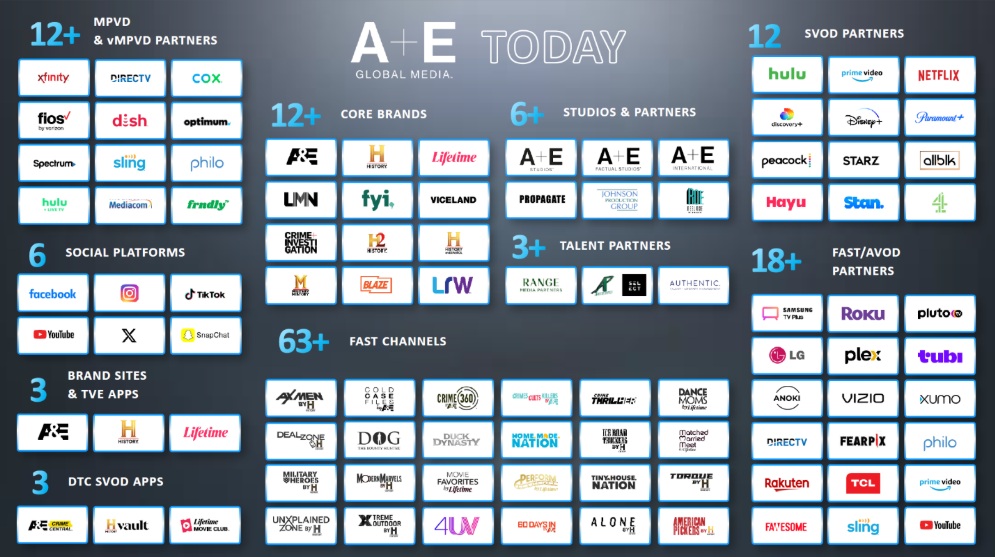
A+E Global Media reaches consumers across traditional television, streaming services, FAST channels, digital platforms, social media, and direct-to-consumer apps.